The gravel out here by the county line has a dry, ringing sound under tires that tells you who is pulling up before you even turn your head toward the yard. I heard my brother Greg’s pickup crunching up the caliche drive three minutes before he slammed his door. He always slammed that driver-side door with a hollow tinny clatter that belonged on a twenty-year-old truck he refused to replace, even though he was pulling six figures as a regional sales manager over in Abilene.
He came up the front steps two at a time, his boots scraping hard against the cocoa mat, and shoved the screen door open without knocking.
“Where is he?” Greg demanded, his face already red around the collar of his golf shirt. “Arthur Miller’s office called my cell ten minutes ago saying the reading is at two. They didn’t say anything about a stray.”
I was standing at the kitchen counter rinsing out the last coffee mug from my breakfast, looking out through the sheer lace curtains at the overgrown crepe myrtles along the fence line. My hands felt stiff, the way they always did when the weather shifted from dry heat to a damp north wind. I didn’t turn around right away. I wanted him to see my back for a second so he’d remember whose house he was storming into.
“He’s not a stray, Greg,” I said, keeping my voice lower than his. “He was invited.”
“Invited by who? Mom’s dead, in case you forgot the headstone we just laid granite on last Thursday.” Greg dropped his leather portfolio onto the Formica table with a loud slap that made the sugar bowl rattle. “She was eighty years old, and toward the end, her head wasn’t even in the same zip code.
You know that. I know that. Bringing some vagrant off the street into a legal probate meeting is a circus act. What’s Arthur going to think?”
“Arthur Miller has practiced law in this county for forty years,” I said, finally turning around to face him. “He doesn’t think in circus acts. He thinks in codicils and ink. If Mom wanted Ethan there, then Arthur put him on the schedule. And Ethan isn’t a vagrant. He’s twenty-four, he’s clean, and he worked harder on this property in three months than you did in the ten years since Daddy passed away.”
Greg let out a sharp, barking laugh that didn’t reach his eyes. “Oh, right. The flower boy. The guy who showed up with grocery bags and a sad story. I suppose you think he deserves a slice of the acreage now, too? Dad left twelve acres of bottomland and a house that’s clear of the bank.
You think we’re splitting that three ways with a kid who smells like second-hand diesel?”
“Nobody said anything about splitting the land,” I said, feeling a familiar, heavy knot tighten right behind my breastbone. “Just sit down and drink a glass of water, Greg. You look like you’re about to pop a gasket.”
“I’m not sitting down,” he snapped, pacing twice across the linoleum before stopping by the refrigerator. “This is ridiculous. I’ve got clients waiting on quotes in San Angelo, and I’m burning an afternoon because you and Mom developed a soft spot for a stray dog.”
The funny thing was, Greg hadn’t cared about the stray dog when Mom was actually alive to ask him over for Sunday pot roast. Back then, Greg was always too busy with regional conventions, golf tournaments, or inventory audits to make the twenty-minute drive out from town. He’d call on his Bluetooth while driving down Interstate 20, talk for four minutes about his commission tier, and then promise he’d catch the next weekend.
The next weekend never came. It didn’t come when Mom fell on the back steps during the ice storm two winters ago, and it didn’t come when her hips started acting up so bad she had to use a four-legged walker to get from the bed to the stove.
The only person who showed up when she needed her groceries carried or her front porch boards screwed down was Ethan.
I remember the exact afternoon Mom met him, because she called me five minutes after it happened, her voice shaking with that funny little flutter she got when she was excited. She had driven her old Buick LeSabre down to the Rexall on Main Street to pick up her blood pressure refill. As she was backing out of the handicap stall, her heavy canvas tote bag had split right down the seam, spilling six cans of creamed corn and a box of saltines across the hot asphalt while other drivers just tapped their horns and swung around her bumper.
Ethan had been sitting on the low brick wall near the alley, eating a ham sandwich out of a wax paper wrapper. He didn’t have much to his name, just a blue nylon backpack with a frayed zipper and a pair of scuffed work boots that had seen better years. But he dropped his lunch right there on the wall, walked over into the traffic lane, and picked up every single rolling can of corn before Mom could even bend her knees.
“He didn’t make me feel old,” Mom told me later that evening over the landline, her voice soft as she looked out her kitchen window. “Most people look at you when you’re eighty and they treat you like you’re already halfway in the dirt. This boy looked me square in the eye, dusted off my crackers, and asked if he could carry the bag to the trunk. Said his name was Ethan. He’s got good hands, honey. Real carpenter’s hands. Broad palms.”
From that Thursday on, Ethan was part of the rhythm of this place. Every week, like clockwork, he’d walk out the three miles from town along the old rail-trail, carrying a spare canvas bag just in case Mom needed feed store supplies or heavy sacks of flour. He didn’t ask for money. Sometimes Mom would try to slip him a twenty-dollar bill when he fixed the loose treads on the back stairs, and he’d just shake his head, tuck his chin down into the collar of his denim jacket, and say, “No ma’am, I’ve got enough for today.”
The trouble started on Mom’s eightieth birthday. Greg had promised he’d fly in from Dallas, he was living up north then, and bring a catered brisket dinner. Mom spent two hours setting the dining room table with the good lace cloth and the silver-plated water pitcher that Daddy had polished every Thanksgiving before he died. At four o’clock, Greg called to say his flight was delayed out of DFW. At six o’clock, he called back to say he had missed the connection entirely because of a regional sales meeting that ran long, and he wouldn’t make it until Tuesday.
Mom hung up the phone, walked into the living room, and sat down hard in her wingback chair without saying a word. The silence in that room was heavy, the kind that feels like lead pressing down on your chest.
Twenty minutes later, the front screen door gave a quiet little squeak. Ethan walked into the kitchen carrying a small bunch of yellow roses wrapped in green florist paper. They weren’t fancy roses; the petals were a bit bruised at the edges, and they cost twelve dollars. Ethan had laid them right in the middle of the lace tablecloth, his knuckles red from the wind.
Mom burst into tears right there at the table. Not soft, quiet tears, but the heavy, gasping sobs of an old woman whose heart had just been dropped on the floor.
“Ethan, why would you spend your last dollar on flowers?” I had asked him later, standing by the screen door while he wiped his boots on the scraper.
He simply shrugged, looking down at his worn-out soles. “Because she deserved something beautiful for her birthday.”
He hadn’t lied. Later on, when Mom’s purse was sitting on the kitchen counter after she passed, I checked her checkbook ledger and remembered Ethan didn’t even have a bank account. That twelve-dollar bouquet was literally everything he had in his pockets that afternoon.
Three months after that birthday, Mom called me over on a Sunday afternoon with a look on her face that was half-terrified and half-defiant. She had poured herself a half-cup of chicory coffee and was stirring it with a silver spoon she’d inherited from her own grandmother.
“I proposed marriage to Ethan,” she said, her voice dropping an octave.
I almost spilled my coffee right onto the oilcloth. “Mom, are you out of your mind? He’s fifty-six years younger than you! People will talk about this from here to Brownwood.”
She gave me that gentle, sad smile that always made you feel like she knew something about the world you hadn’t learned yet. “I know, sweetheart. I just wanted to make sure he had a place to live and somebody to care for him. He sleeps behind that old brick bookstore on 4th Street, and the nights are getting too cold for a boy with a bad chest. A marriage certificate is just paper, but it gives him a roof that won’t leak when the winter rains come.”
Ethan had turned her down, of course. He told her he couldn’t marry her just to have somewhere to sleep, that her kindness was worth more to him than a roof bought out of pity. But the damage, if you could call it that, was already done. Mom loved him like the son Greg had stopped pretending to be years ago.
When she passed away peacefully in her sleep three months later, the legal formalities began almost immediately. Greg flew in for the funeral, wore a very expensive black suit that smelled faintly of dry cleaner plastic, and shook hands with everyone at the Methodist church like he was running for county commissioner. But the moment the funeral was over, his mind went straight to the ledger.
“Let’s get this over with,” Greg muttered, checking his watch as we turned our cars toward Arthur Miller’s office on the courthouse square. “Arthur’s office charges two hundred an hour just for sitting in that leather chair. Let’s see what the damage is.”
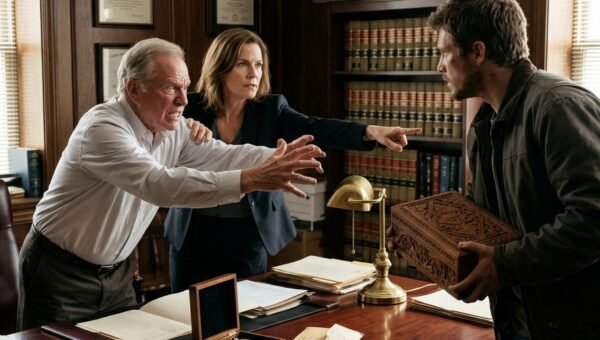
Arthur Miller’s office smelled of old law books, floor wax, and peppermint drops. The blinds were pulled halfway down against the blinding Texas sun, casting long, dusty stripes across the oak conference table. Arthur sat at the head of the table with a thick manila folder spread open before him, his half-moon reading glasses perched on the very tip of his nose.
Greg and I took our seats on the left side of the table. Ethan sat quietly on the wooden bench just outside the frosted glass door until I got up, opened it, and told him to come on in. He was wearing a dark blue sport coat that was a little too short in the sleeves, something I suspected he’d picked up at the Goodwill on Vine Street, and he carried his blue nylon backpack in his lap like it was a shield.
Greg didn’t even look up when Ethan walked in. He just stared straight at Arthur Miller and tapped a gold-plated fountain pen against the blotter.
“I see we brought an audience,” Greg said, his voice dripping with vinegar. “Arthur, I wasn’t aware the Texas probate code allowed for spectators during the reading of a private family testament.”
Arthur Miller didn’t blink. He took off his glasses, folded them deliberately, and laid them on top of the manila folder. Arthur had known our father back when they both served on the drainage district board, and he had a way of looking at people that made you feel like he knew what you had for breakfast three days ago.
“This isn’t a spectator sport, Gregory,” Arthur said, his voice dry as corn husks. “Your mother left specific written instructions, executed under my supervision four days before she passed away. Every person seated at this table has a designated interest in these proceedings.”
Greg scoffed, shaking his head. “Interest? The boy cuts grass. If Mom gave him twenty bucks for his trouble, fine, write him a check out of the petty cash and let him catch a bus back to wherever he came from.”
“He didn’t come from anywhere, Mr. Miller,” Ethan said quietly. His voice was lower than I remembered, steady and flat, without a trace of anger in it. “I’m right here.”
Arthur gave Ethan a short, respectful nod. Then he reached down beside his chair and lifted something heavy onto the green leather blotter.
It was a hand-carved cedar box with a brass latch shaped like an acorn. The wood was dark, rubbed smooth with boiled linseed oil over decades of handling, and it smelled faintly of dried rose petals and old iron. It was our father’s cedar box, the one he had kept in the back of his workshop since the day he retired from the lumberyard. For as long as I could remember, that box had lived on the top shelf of the bedroom closet, holding receipts, old snapshots of my parents in their courting days, and a few small family heirlooms.
Greg stopped tapping his pen. His whole body went rigid, the color draining right out of his cheeks until he looked like he’d swallowed a lemon.
“Where did you get that?” Greg asked, his voice suddenly three pitches higher than normal. “That box belongs in the estate inventory. That’s family property.”
“Your mother gave it to me to hold in safekeeping three months ago,” Arthur said evenly. He slid the cedar box across the polished wood toward Ethan. “And she left specific instructions regarding its contents.”
Greg stood up so fast his chair screeched against the parquet floor. “Don’t let him open it!”
His voice cracked on the last word, bouncing off the wood-paneled walls like a gunshot. Sweat was already beading up along his hairline, dark patches forming under the arms of his expensive golf shirt. He looked less like a regional sales manager and more like a kid caught stealing apples off a neighbor’s tree.
I stood up right beside him, planting both hands flat on the table. “Sit down, Greg. Why are you sweating like a sinner in church over a wooden box?”
“It’s… it’s a violation,” Greg stammered, his eyes darting toward the door as if he wanted to bolt. “It’s personal items. Daddy’s papers. That boy has no right touching family heirlooms.”
“Sit down, Gregory,” Arthur Miller repeated, and there was a cold, iron weight in the old lawyer’s tone that brooked no argument. “Or I will have the bailiff from next door escort you into the hallway. You may take your seat.”
Greg dropped back down into his leather chair, his hands trembling slightly as he folded them in his lap. He kept his eyes locked on the brass latch of the box, his breathing shallow and fast.
Ethan looked at me, then down at the box. His fingers were long and calloused, the nails trimmed short. He reached out very slowly, his hand steady even though mine was shaking just watching him, and lifted the brass latch. It gave a soft, dry click that sounded unnaturally loud in the quiet room.
When he raised the lid, the sharp, clean scent of aged cedar rolled out over the table, mixed with the faint, sweet smell of dried yellow roses.
Inside, resting on a bed of old flannel rags, was a heavy gold pocket watch with an engraved hunting case, our grandfather’s watch, the one Daddy had carried every Sunday until the day he died. Right beside it lay a folded envelope with my mother’s neat, sloping handwriting across the front, and a set of heavy brass keys on a frayed leather fob.
Ethan didn’t touch the watch. He looked at the envelope with my name and his name written together in blue ink.
“Read it, Arthur,” I whispered.
Arthur Miller picked up the envelope, slit the top with a silver letter opener, and unfolded a single sheet of lined tablet paper. He cleared his throat once, adjusted his glasses, and began to read in that slow, measured courtroom voice that made every word feel heavy as lead.
“To whoever is sitting in this room,” Arthur read, “if Greg is shouting, it’s because he knows what’s inside. Three months ago, I went to the cedar box to get your father’s gold watch so I could have the crystal repaired. The box was unlocked, and the watch was gone. In its place was a pawn ticket from a shop on 8th Street in Abilene, made out in Gregory’s name, for three hundred dollars. Greg told me he needed emergency cash for his mortgage. He told me he’d pay it back before I ever noticed. But he forgot one thing. He left the carbon receipt in the kitchen trash can.”
Greg let out a low, choking sound, pressing both hands over his face.
Arthur didn’t look up; he just kept reading. “I didn’t call the police, and I didn’t call Greg. I drove down to that pawn shop myself the next morning, used my own grocery money to redeem your father’s watch, and brought it back home where it belongs. Greg thinks family is something you use when you’re short on cash and ignore when you’re busy. He thinks a mother’s memory is a line item on an expense report.”
Arthur paused, his eyes shifting from the paper over to Ethan, who sat motionless with his hands resting on the edge of the table.
“As for the house and the savings,” Arthur continued, “those are divided equally between my two children under the main will, because the law says they must be. But this box, and everything inside it, belongs to Ethan. The gold watch is for him to carry as an honest man. The brass keys are to the backyard carpentry workshop where my husband spent forty years building things with his hands. The locks have been changed. The tools inside are restored and waiting. There is five hundred dollars in a savings account at the First National Bank attached to the workshop deed to buy timber and nails. A penniless boy brought me twelve-dollar yellow roses when I was lonely and forgotten, while my own flesh and blood traded my husband’s honor for three hundred dollars at a pawn counter. Let Ethan build something that lasts.”
The room was so quiet you could hear the electric clock on the wall ticking off the seconds, *tick, tick, tick*, like a small heart beating inside the wood paneling.
Greg didn’t say a word. He sat there with his head down, his shoulders hunched inside that expensive black suit, looking smaller than he had in twenty years. All his bluster, all his regional sales targets, all his sharp-elbowed confidence had vanished the moment those words hit the air. He had tried to hide his theft behind a wall of arrogance, and his own mother had outlived him in ink.
I reached out and touched Ethan’s sleeve. The rough denim felt cold under my fingers. He wasn’t smiling. He wasn’t gloating. His eyes were fixed on the gold pocket watch, and I could see the reflection of the brass case shimmering in the moisture lining his lower lids.
“She believed in you, Ethan,” I said softly.
He swallowed hard, his throat moving once, before he finally spoke. “She didn’t have to. I just liked talking to her about the old days.”
“Well,” Arthur Miller said, folding the letter with a sharp crease of his thumb and laying it back inside the box. “The legal requirements of this addendum have been fully satisfied. The workshop is deeded in Ethan’s name as of this morning. Greg, you have thirty days to clear your remaining belongings out of the guest room in the main house, or they go to the charity bin.”
Greg stood up without looking at either of us. He didn’t slam the door on his way out this time; he pulled it shut with a small, pathetic click that didn’t even rattle the frosted glass.
An hour later, Ethan and I walked out the heavy oak doors of the courthouse and down the limestone steps into the bright afternoon glare. The air smelled of hot asphalt and dry grass, the real Texas wind kicking up dust devils along the curb where the pickup trucks were parked.
We didn’t drive back to the house together. Ethan walked out the three miles along the rail-trail the way he always had, his blue backpack slung over one shoulder, but this time he carried the cedar box under his arm like it was made of spun glass. I followed behind him in my station wagon, idling my engine just enough to keep pace with him as he turned off the county road onto our gravel drive.
When we got to the house, the sun was sitting right on top of the western fence line, turning the old galvanized tin roof of the backyard carpentry workshop the color of burnt copper.
Ethan walked straight past the back porch, pushed open the heavy double doors of the workshop that hadn’t been unlocked since Daddy passed away, and stepped inside. The air in there smelled of aged pine sawdust, linseed oil, and iron shavings, a smell that hadn’t changed in forty years.
He set the cedar box down gently on the center workbench, right where Daddy used to lay out his marking gauges and try squares. Then he reached into his pocket, pulled out a small glass jar he must have found somewhere along the road, and filled it with a little tap water from the utility sink.
He didn’t say anything. He just reached into his coat pocket, pulled out a single yellow rose, bruised at the petals, picked from the wild bunch I had left in a vase on the kitchen counter, and slid it down into the center of the jar.
The late afternoon sunlight slanted through the dirty, twelve-pane window above the workbench, catching the dust motes dancing in the air and turning the yellow petals into something that looked almost like fire against the gray wood. Ethan stood there for a long time with his hands resting flat on the edge of the old oak table, looking out toward the pasture where the crepe myrtles were rustling in the wind, and for the first time since Mom stopped breathing, the house felt like it was finally finished.